

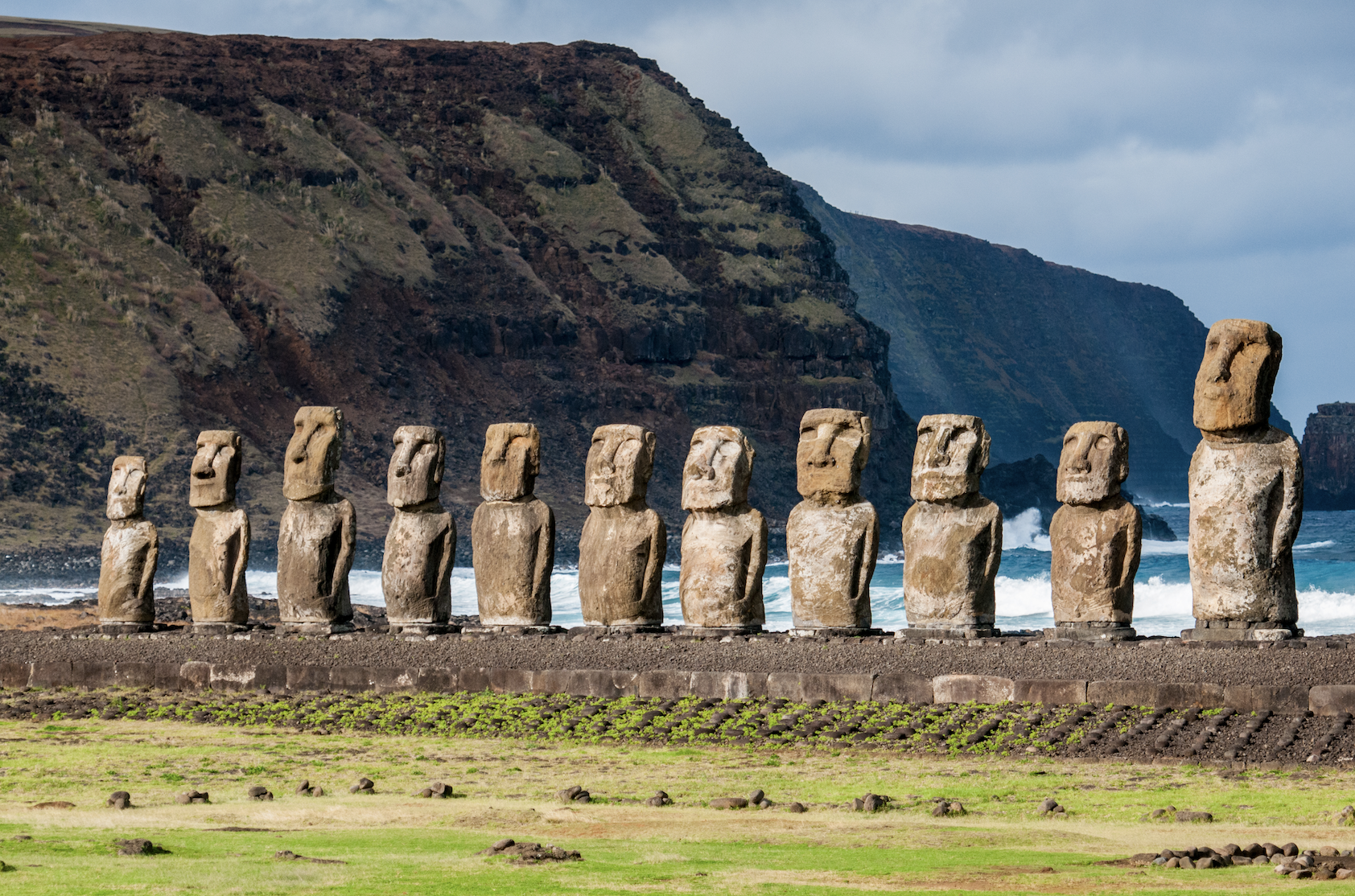
You likely already know that’s a trick question. This tiny dot in the eastern South Pacific Ocean, but technically a territory of Chile, is actually properly called Rapa Nui.
The world over, Easter Island has been synonymous with exotic mysteries of an impossibly distant, long-lost civilization and mind-boggling human endeavor.
It may be the most remote inhabited island on the planet. Only a few thousand people live on this remnant of oceanic volcanoes sticking out of the sea, and that's the first miracle itself. The closest inhabited island is 1300 miles away (Pitcairn Island with only 50 people), and the nearest continental point is Chile, over 2000 miles away. Local tales say a 2-canoe Polynesian expedition around AD 700 was the start of Rapa Nui's extraordinary story.
Today, Easter Island is on the map as one of the corners of the millions of square miles of the Pacific Ocean known as Polynesia – the other corners for easy reference are Hawai’I and New Zealand. And it’s on the map of global travelers who want to come face to face with the island's nearly 1000 moai at its UNESCO World Heritage Site.
Monuments to the Past
These stately, solemn statues were carved during a 500-year period in the island's history, beginning a thousand years ago. The moai share artistic characteristics with Polynesian carvings, confirming the origin tale of the Rapa Nui people. Chiseled with only stone tools out of volcanic rock in the 'quarry' of an extinct volcano, each statue took a team of half a dozen artisans about a year to complete. The largest is over 30 feet long and weighs 90 tons. They were an incredible feat of creativity, production, and organization.
You probably think of them as 'Easter Island heads'. But the moai actually have torsos, and some even have complete lower bodies; they were just buried up to their necks over the centuries by shifting sands.
These monumental statues represented deceased ancestors. And only about a quarter were originally installed; others were left in the quarry or remained en route to their intended locations. All but 7 faced inland, the spirits of the deceased 'watching over' the living and their lands. The 7 facing the sea stood as wayfinders for seafarers.
Many moai were toppled after the mysterious collapse of the Rapa Nui society in the 19th century. In recent decades, local and international efforts have restored and re-mounted a number of moai. This dot on a map in Chilean Polynesia still seems as awe-inspiring and as full of hidden secrets as when explorers first arrived.
Timing is Everything
Which brings us to: Why is it called Easter Island? The Dutch explorer who was the island's first-recorded European visitor arrived on Easter Sunday in 1722 – he came upon it while searching for another island. (He must have been pretty lost!) So 'Easter Island' it was dubbed, and its current official Spanish name in Chile is still Isla de Pascua, while its Polynesian name is Rapa Nui, in the local language: the 'naval of the world'.
There's more to Rapa Nui than the silent witness of the moai to the island's past. Visitors experience the local version of Polynesian culture, explore pink-sand beaches, caverns, and dive sites, cycle, hike, or ride horses across prairies and volcanic hillsides, and even surf on those waves so distant from other shores.
How to get there? You can fly from both Chile and Tahiti, participate in tour packages offered by expedition and exotic travel experts, arrive by small or expedition cruise ship, or by private yacht.
There may be nowhere else in the world where a traveler can feel the greatness of human achievement and small in the face of a culture so far across the waves.
START YOUR TRIP!
By: Lynn Elmhirst, travel journalist and expert.
Images: Getty
All rights reserved. You are welcome to share this material from this page, but it may not be copied, re-published, broadcast, rewritten, or redistributed.
Start your trip to
Let us help you plan your trip
Featured Experiences

AmaWaterways and Smithsonian Journeys Partner on Collection of River Cruises
AmaWaterways’ river cruise ships will host an exclusive c... more

Riverside Luxury Cruises’ Early Booking Bonus: up to 18% Discount
For a limited time, Riverside Luxury Cruises offers doubl... more

Take Your Winter Vacation to New Levels of Luxury at Aman Resorts
Don’t just escape winter – discover vibrant city sanctuar... more

NEW Roam by Tauck Launches 2026 Journeys in 9 Countries; Adds More for 2027
The unique, new Tauck brand for travelers in their 40s an... more

Insight Vacations, Other TTC Land Tour Brands Offer Savings Up to 30% Off Early Bookings for 2027
TTC Tour Brands, a leading global tour operator and its a... more
“Free at Sea Plus” Package Returns at Norwegian Cruise Line
Releasing its winter 2027/28 deployment, Norwegian Cruise... more
Popular Posts
- 8 Facts About the Panama Canal
- 10 Amazing Facts about the Tasmanian Devil
- Top 10 Reasons to Travel to Croatia
- Lie Flat Beds in Economy Class? This Airline Says, "Yes, You Can!"
- See the World's Tallest Indoor Waterfall at this New Airport
- Fact or Fiction? 3 Things You Need to Know About 'Dracula's Castle'